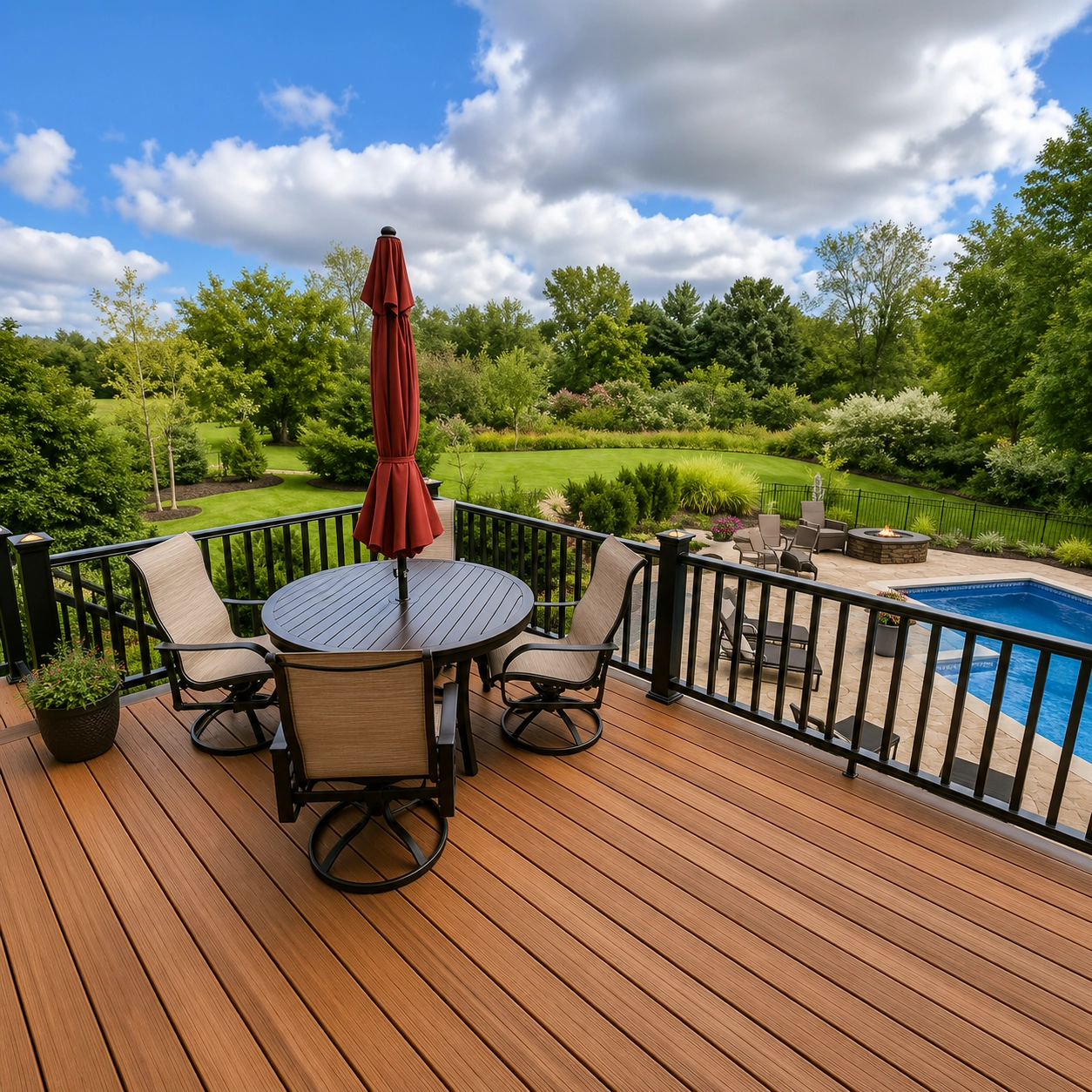
A few years ago, almost nobody asked me what was inside their deck boards. Now I hear it on half my consultations. Homeowners have been told a lot of things, some of it true, some of it scare tactics from a salesperson trying to close. After more than twenty years building decks across West Michigan, here is the straight version: what composite decking actually is, how it compares to wood, and how to choose without getting talked into something you do not need.
What Composite Decking Actually Is
Composite is not one single thing, and that is where most of the confusion starts. Take a TimberTech composite board. The core is a mixture of plastic and wood fiber, and that blend is what makes it composite. The board is then wrapped, or capped, in a PVC shell that protects it from moisture, stains, and fading.
So a capped composite board does have a wood component inside it, sealed under the cap. Trex works the same way. The wood fiber is part of what gives composite its strength and its natural look.
Then there is full PVC decking, like TimberTech AZEK. That has no wood product in it whatsoever. It is the option I reach for when a homeowner’s main concern is moisture, mold, or wood content of any kind.
Years ago nobody would ask what is inside a composite deck. Today they do, because the industry trained them to. That is fine. We would rather be the ones with the honest answer.
The Wood and Mold Myth, From the Job Site
Here is the conversation I keep having. A homeowner talks to a competitor, hears that boards with any wood inside will grow mold, and comes to me worried. One local company pushes a rice-husk product with no actual wood and builds the whole pitch around scaring people away from anything with wood in it.
When someone raises that with me, I ask a simple question: you have a full wood deck in the backyard right now. Is it covered in mold? Almost always the answer is no. If a bare wood deck out in the weather is not molding, a wood fiber that is sealed inside a PVC cap is not the thing to lose sleep over.
That said, if no wood at all is what gives you peace of mind, that is exactly what AZEK is for. Full PVC, nothing inside to question. I would rather match you to the right product than win an argument. Both paths get you a deck that lasts.
TimberTech, AZEK, and Trex: Which Composite Is Right for You
We are a TimberTech Platinum certified contractor, so TimberTech and AZEK are the lines we build with most and know best. We install Trex as well. Here is the honest, plain-language difference.
| Factor | TimberTech | AZEK | Trex |
|---|---|---|---|
| Make-up | Capped composite, wood-polymer core | Full PVC, no wood | Capped composite, wood-polymer core |
| Wood inside | Yes, sealed under a cap | None at all | Yes, sealed under a cap |
| Heat underfoot | Cooler than wood | Coolest, absorbs least heat | Cooler than wood |
| Stain and fade | Excellent | Best, longest warranty | Very good |
| Best for | Most builds, warm wood look | No-wood peace of mind, full sun | Recognized brand, value composite |
One real-world note on heat: full PVC like AZEK runs a little cooler and moves a little less than a composite board does, which matters if your deck bakes in afternoon sun. We will walk your yard and steer you to the right line and color for how the space actually gets used.
If you want the deeper version on materials and lines, see our Composite Decks.
Composite vs Wood: The Real Trade-Off
Wood and composite both have a place, and which one is right depends on what you actually want out of the deck.
Wood costs less upfront. If budget is the deciding factor, a pressure-treated wood deck gets you outside for the lowest entry price. The trade-off is upkeep: sanding, staining, and sealing every couple of years, and a shorter lifespan before boards cup, splinter, and need replacing.
Composite costs more to install and earns it back over time. No staining, no sealing, just a wash now and then, and a board that holds its color and surface for decades. Most homeowners who tell me they never want to think about maintenance again end up on composite for exactly that reason.
| Factor | Composite | Pressure-Treated Wood |
|---|---|---|
| Upkeep | Wash only | Sand, stain, seal every 2 to 3 years |
| Lifespan | 25 to 50 years | 10 to 15 years |
| Color | Holds for decades | Grays and fades |
| Surface | Splinter-free | Splinters and cracks over time |
| Upfront cost | Higher | Lower |
| Cost over 20 years | Lower once upkeep is counted | Higher with refinishing |
Want real numbers for your size and material? Our Deck Pricing Guide breaks down cost by deck type and size, plus Kent County permit costs and financing.
The Part of Your Deck That Rots First
Here is something the board debate misses entirely. The first thing to fail on a deck is usually not the surface. It is the wood in the ground. Posts set in the soil are the part most likely to rot over time, no matter what you put on top.
That is why we started using galvanized ground screws instead of traditional wood posts in the ground. They are metal, they do not deteriorate the way buried wood does, and they give your deck a foundation built to outlast the boards. You can spend on a premium composite surface, but if the structure under it is buried wood, you have spent on the wrong end.
Thinking About Saving Your Old Frame?
I get this all the time. A homeowner wants to keep their existing frame and just put new boards on top. There is nothing visibly wrong with it, and it is twenty years old.
Here is the math I walk them through. You are putting brand new product that costs more than the frame onto a twenty year old structure, and hoping that frame lasts another fifty years to match the new boards. It usually does not save what people think it does. Sometimes resurfacing makes sense. Often it does not. I will tell you honestly which one you are looking at, because the goal is a deck that lasts, not the lowest invoice today.
Frequently Asked Questions
Is there wood inside composite decking?
It depends on the board. Capped composite like TimberTech and Trex has a wood fiber and plastic core sealed under a PVC cap, so there is a wood component inside. Full PVC decking like AZEK has no wood at all.
Do composite decks get moldy?
A wood fiber sealed inside a PVC cap is not the same as exposed wood, and it is not something to worry about for a normal deck. If you want zero wood content for peace of mind, full PVC AZEK has none.
Does composite decking get hot in the sun?
Composite runs cooler than wood, and full PVC like AZEK runs the coolest and absorbs the least heat. Color choice matters too, and we will steer you to the right tone if your deck gets full afternoon sun.
Is composite worth it over wood?
Composite costs more upfront and earns it back. You skip years of staining and sealing and avoid an early replacement, so over twenty years it is usually the lower total cost and far less work.
What lasts longer, the boards or the frame?
Often the structure in the ground fails before the surface. That is why we set decks on galvanized ground screws instead of buried wood posts, so the foundation outlasts the boards on top.
Build It Once, Build It Right
Whether you land on composite or wood, the deck should be built to last and matched to how you actually live. We give honest answers, no pressure, and a crew that treats your home like its own.